READ: We watched antisemitism at TMU from the sidelines. Silence isn't an option

AVI Student Ambassadors pen powerful op-ed in The Toronto Sun on culture of anti-Jewish hatred on campus at Toronto Metropolitan University
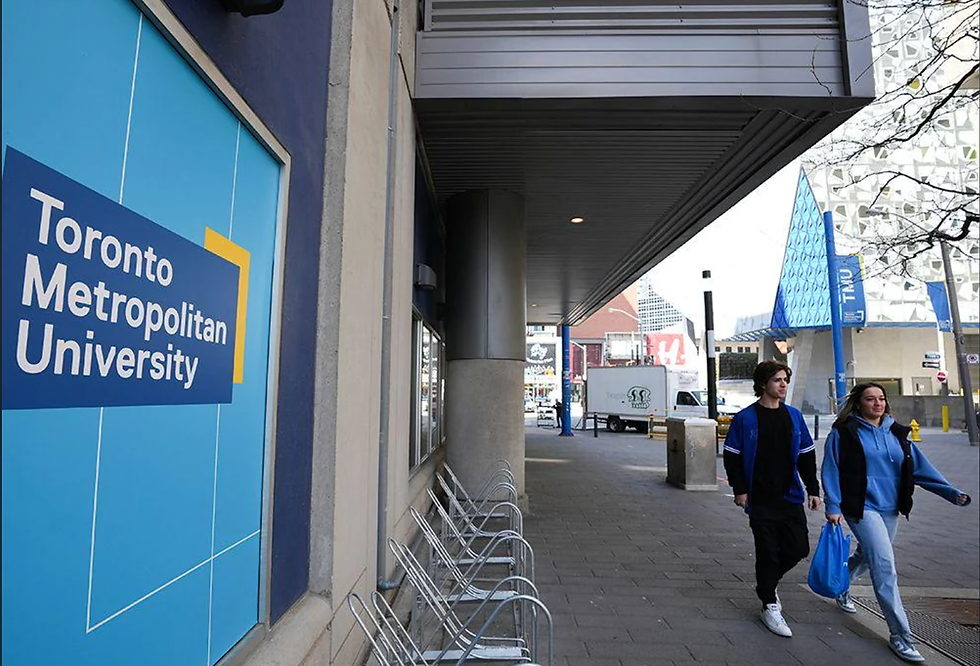
“As two students who don’t fit the profile people expect to see in Jewish spaces — one of us Black and Jewish, the other Iranian — we’ve had a unique and at times painful vantage point on TMU’s campus,” write Cielle and Anthony
On behalf of all of us at Allied Voices for Israel (AVI), we hope you had a meaningful Rosh Hashanah surrounded by family and friends this past weekend.
Last week marked the first week back to campus for students across the country. For far too many Jewish students and our allies at campuses like Toronto Metropolitan University (TMU), Simon Fraser University and Concordia University, it also marked a return to the anti-Jewish hatred and hostility they've had to confront simply for being students of conscience, and especially for being Zionists.
We saw this firsthand last semester at TMU, and the findings of the recent Benotto Report make clear it's likely to continue this semester unless real, concrete action is taken. This starts with ensuring that those tasked with addressing antisemitism on campus aren't themselves part of the problem.
In response to this culture of hatred on campus, two brave AVI student ambassadors at TMU — Cielle and Anthony — have penned a powerful op-ed published in today's Toronto Sun.
Writing as students who don't fit the mold of what people expect a “Jewish student” to look like — one Black and Jewish, the other Iranian — they share what they've witnessed from the sidelines, why silence is no longer an option, and how getting involved with organizations like AVI has helped them bring conversation back to campus and educate their peers, Jewish and non-Jewish alike.
Please read their op-ed in its entirety below.
We watched antisemitism at TMU from the sidelines. Silence isn't an option anymore
As two students who don't fit the profile people expect to see in Jewish spaces – one of us Black and Jewish, the other Iranian – we've had a unique, and at times painful, vantage point on TMU's campus. We've watched this divide from both sides.
Beneath the division and hostility on campus, the simple truth is that people are hurting. In every protest, feelings of being unheard and dismissed are the motivators. Beneath the outbursts – every disrupted lecture, every crashed event – sits an inconsolable grief. That pain exists in both Jewish and pro-Palestinian communities, whether either side wants to admit the similarity or not. But instead of connecting us, it has divided us further, fermenting into a widespread tension fueled by an administration that has consistently failed to respond.
Which is why we're writing this. Intense emotion is natural. Violence is not. Shaming is not. Intimidation is not.
On October 29, 2024, a downtown protest spilled into the Student Learning Centre (SLC), ending with a Jewish student's phone smashed on the floor. On October 7, 2025 – the same day Jewish students gathered to mourn – a counter-memorial urged attendees to “bring your anger.” By November, a private campus event was disrupted, leaving one person physically hurt and two students arrested.
That's only a fraction of what Jewish students have endured. Beyond the headlines are the daily, lower-frequency microaggressions: hostile glances, whispered remarks, uncomfortable comments during lectures. Since October 7, 2023, campus life has lost its sense of safety.
In response to three years of escalating uproar, TMU appointed Justice Mary Lou Benotto in 2025 to review major campus disruptions and recommend how to balance free expression with campus safety. Her conclusion was clear: a lack of transparent enforcement around protest boundaries has created a perception that disruptive behaviour carries zero consequences. Crucially, Benotto noted TMU already has policies capable of addressing this – it has simply failed to apply them consistently.
Yet despite a clear directive, TMU has chosen to delay again. Following the Benotto report's release in August 2026, President Mohamed Lachemi announced yet another committee: the President's Implementation Task Force, mandated to develop a plan by March 2027. Notably, that task force includes no members from Jewish organizations on campus. So we have to ask: why are there no Jewish students or faculty at the table? How can someone with no first-hand experience of antisemitism be expected to defend Jewish students effectively?
For Jewish students, this means another full academic year of uncertainty, vulnerability, and unresolved harm. Forming a task force to study solutions that have already been laid out looks less like thoughtful leadership and more like stalling – at the direct expense of student safety.
As two students on the sidelines, never the main targets of these outbursts, we've each witnessed the consequences firsthand, from different angles.
One of us is Iranian, and doesn't carry the weight of having an identity politicized the moment we walk into a student lounge – but the friends we care about do. I remember being curious about Hebrew, sensing it might share roots with Persian. One day at the SLC, I asked my friend, V, to write out some Hebrew and Russian letters on a whiteboard to teach me. The moment V started writing in Hebrew, we noticed the deathly glares of other students around us. I immediately told V to erase the letters, and we packed up and left. An environment where you can't even separate language and culture from politics is hostile and discriminatory.
The other of us is Black and Jewish, not immediately perceived as Jewish, and so doesn't experience the public humiliation some visibly Jewish friends do. After the February 23, 2026 incident, when expired milk was thrown at Jewish students and Israelis peacefully tabling on campus, I overheard a Jewish first-year student crying to a friend. She'd been interested in getting involved with Jewish life on campus, but watching that incident seemed to make her realize, maybe for the first time, that openly representing the Jewish community at TMU comes at a cost. It means making yourself vulnerable, risking humiliation, and, at times, even putting your personal safety at risk.
We used to think our position on campus shielded us from the conflict on campus – cushioned by the quiet safety of the sidelines, never publicly humiliated, doxxed, or confronted. We've since realized that safety was never really ours to keep; it was just proximity to a fight we hadn't yet been asked to join.
We are all students. We're here to learn safely, without disruption, to experience the university life TMU promises every fall at Orientation – a promise it keeps making to new students while failing to acknowledge the broken system it's sending them into. Having witnessed these events firsthand, we're asking TMU to do better: to live up to its varsity team name, to actually be “bold.”
Ciellie and Anthony are both AVI Student Ambassadors at Toronto Metropolitan University


Comments